
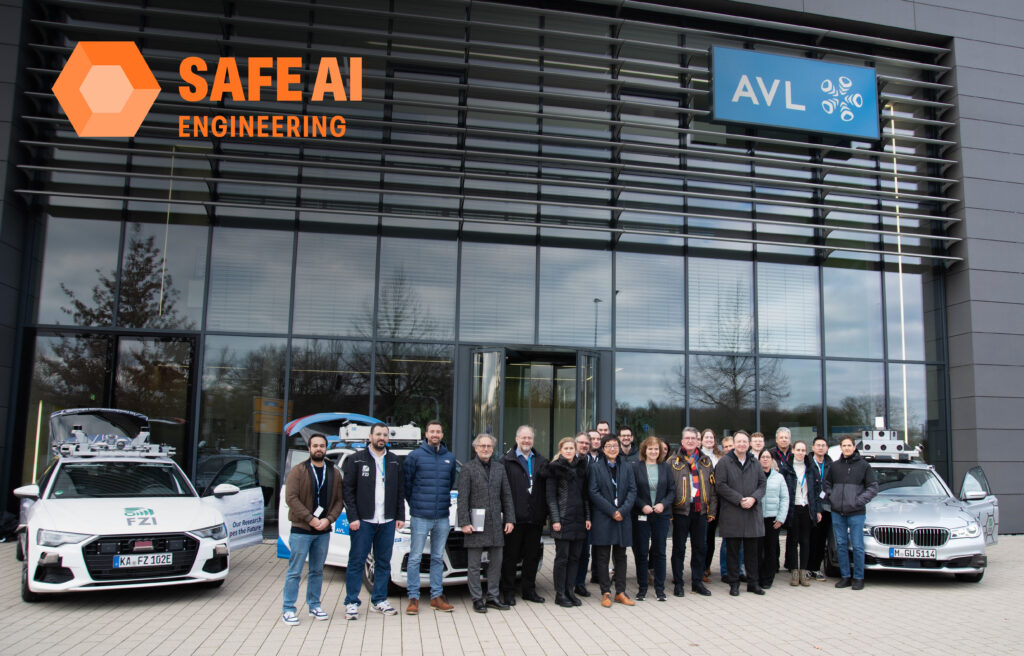
At the end of November, the Safe AI Engineering project reached an important milestone: the demonstration of Use Case 1 at the AVL Tech Center in Bietigheim-Bissingen. The aim of the project is to develop a practical methodology that can be used to design AI functions that are reliable and safe in the long term. This methodology will be further developed over three years in three use cases of increasing complexity.
The day began with a comprehensive presentation of the methodology developed in the project and the approaches for implementation based on Use Case 1. The focus was on a stationary vehicle and a stationary pedestrian on a straight road – a seemingly simple scenario that nevertheless poses important challenges for the safe design of AI functions.
In the second part of the day, simulations were presented and participants were able to experience live demonstrations in test vehicles to see what it means to design AI functions safely, what obstacles there are, and how these can be overcome, based on the example of Use Case 1.
First, the integration of several components was presented, such as threat metrics for functional evaluation and an adversarial loss monitor for monitoring the AI function. A detailed safety argumentation that takes relevant standards into account was available for all components.
The components for assuring AI functions were integrated into the three demo vehicles from FZI, KIT, and AVL. Participants were able to experience and test pedestrian detection live. Additionally the AI model including safety zones, error detection through structured redundancy, the measurement of the probability and potential severity of possible collisions were presented.
With the successful completion of the first iteration, the way is now paved for mastering more complex situations and continuing development toward a scalable and automatable methodology. The second use case will start in 2026.
Picture: AVL Deutschland